

Derek Jacobi experienced a instance of it while on a global production of Hamlet. Bill Nighy grappled with it before The Vertical Hour premiering on Broadway. Juliet Stevenson has likened it to “a malady”. It has even prompted some to take flight: One comedian went missing from Cell Mates, while Lenny Henry exited the stage during Educating Rita. “I’ve utterly gone,” he said – although he did return to conclude the show.
Stage fright can cause the shakes but it can also trigger a full physical paralysis, as well as a utter verbal drying up – all right under the gaze. So for what reason does it seize control? Can it be conquered? And what does it feel like to be gripped by the performer’s fear?
Meera Syal describes a classic anxiety dream: “I find myself in a outfit I don’t recognise, in a character I can’t recall, looking at audiences while I’m unclothed.” A long time of experience did not leave her immune in 2010, while acting in a preview of Willy Russell’s Shirley Valentine. “Performing a solo performance for an extended time?” she says. “That’s the aspect that is going to give you stage fright. I was honestly thinking of ‘doing a Stephen Fry’ just before the premiere. I could see the way out leading to the courtyard at the back and I thought, ‘If I escaped now, they wouldn’t be able to catch me.’”
Syal found the courage to remain, then quickly forgot her words – but just persevered through the haze. “I faced the abyss and I thought, ‘I’ll get out of it.’ And I did. The role of Shirley Valentine could be improvised because the entire performance was her talking to the audience. So I just made my way around the set and had a brief reflection to myself until the lines came back. I winged it for several moments, saying complete nonsense in role.”
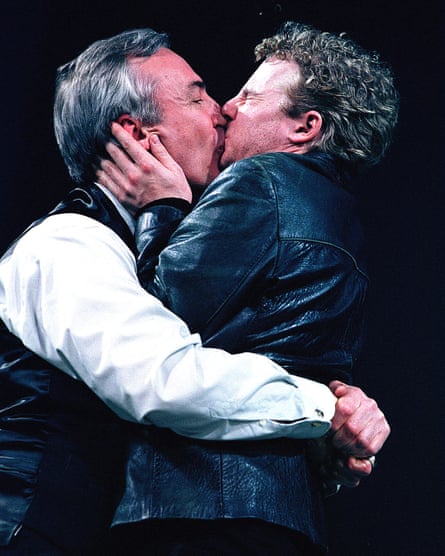
Larry Lamb has contended with severe anxiety over years of theatre. When he started out as an amateur actor, long before Gavin and Stacey, he loved the preparation but performing filled him with fear. “The minute I got in front of an audience,” he says, “it all started to get hazy. My legs would begin shaking wildly.”
The performance anxiety didn’t lessen when he became a pro. “It persisted for about 30 years, but I just got better and better at concealing it.” In 2001, he forgot his lines as Claudius in Hamlet, for the Royal Shakespeare Company. “It was the early performance at Stratford-upon-Avon. I was just into my initial speech, when Claudius is speaking to the people of Denmark, when my lines got lost in space. It got increasingly bad. The whole cast were up on the stage, staring at me as I utterly lost it.”
He got through that performance but the leader recognised what had happened. “He saw I wasn’t in control but only looking as if I was. He said, ‘You’re not engaging with the audience. When the spotlights come down, you then ignore them.’”
The director kept the audience lighting on so Lamb would have to acknowledge the audience’s presence. It was a turning point in the actor’s career. “Slowly, it got better. Because we were staging the show for the bulk of the year, gradually the anxiety vanished, until I was self-assured and openly connecting to the audience.”
Now 78, Lamb no longer has the stamina for plays but relishes his live shows, performing his own verse. He says that, as an actor, he kept interfering of his persona. “You’re not permitting the space – it’s too much you, not enough persona.”
Harmony Rose-Bremner, who was selected in The Years in 2024, concurs. “Self-consciousness and insecurity go contrary to everything you’re trying to do – which is to be free, relax, totally lose yourself in the part. The question is, ‘Can I allow space in my head to permit the persona through?’” In The Years, as one of five actors all acting as the same woman in distinct periods of her life, she was delighted yet felt intimidated. “I’ve grown up doing theatre. It was always my happy place. I didn’t ever think I’d ever feel performance anxiety.”

She recollects the night of the opening try-out. “I truly didn’t know if I could perform,” she says. “It was the only occasion I’d experienced like that.” She coped, but felt overcome in the very opening scene. “We were all motionless, just talking into the dark. We weren’t looking at one other so we didn’t have each other to bounce off. There were just the words that I’d listened to so many times, reaching me. I had the standard signs that I’d had in small doses before – but never to this level. The sensation of not being able to take a deep breath, like your air is being extracted with a vacuum in your chest. There is nothing to hold on to.” It is intensified by the sensation of not wanting to fail cast actors down: “I felt the responsibility to the entire cast. I thought, ‘Can I endure this immense thing?’”
Zachary Hart points to insecurity for causing his stage fright. A lower back condition prevented his hopes to be a athlete, and he was working as a machine operator when a companion submitted to acting school on his behalf and he got in. “Appearing in front of people was totally alien to me, so at training I would wait until the end every time we did something. I stuck at it because it was total escapism – and was better than industrial jobs. I was going to give my all to beat the fear.”
His initial acting job was in Nicholas Hytner’s Julius Caesar at the Bridge theatre. When the cast were informed the play would be recorded for NT Live, he was “frightened”. A long time later, in the initial performance of The Constituent, in which he was selected alongside James Corden and Anna Maxwell-Martin, he uttered his opening line. “I heard my voice – with its strong Black Country dialect – and {looked


